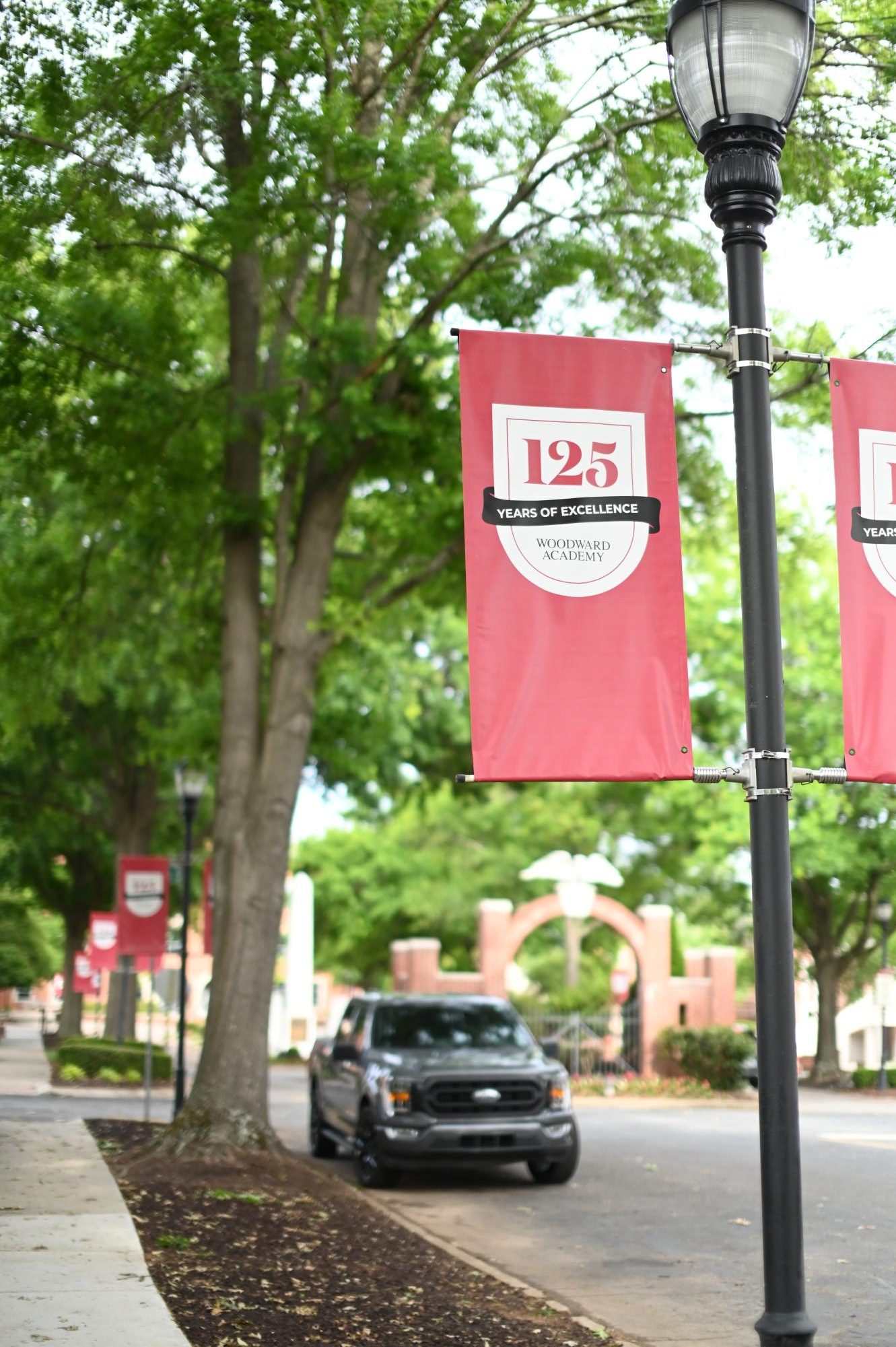
This story is about Woodward Academy’s new strategic plan. Ah, go on, read it anyway.
Since you’re still here, I’m assuming you want to learn all about it.
How about we start with an analogy? A cruise ship will always be fully staffed, slow to maneuver, leave the dock at the “all aboard” time and include an all-you-can-eat salad bar. A cruise has a carefully planned social itinerary and a nautical route prepared for each voyage– just like how Woodward Academy is realizing a strategic plan in the background of every school day. Woodward has a salad bar, too. Every action taken at the Academy has been carefully considered with the best interest of its students in mind.
The Academy drafted a strategic plan that will steer it for the next five to seven years by dint and leadership of the task forces and under the guidance of President Dr. Chris Freer, the Senior Staff and the Governing Board. A strategic plan is, yes, this is bonkers, a physical plan or document that defines the future direction of an institution.
“It basically outlines where we’re going, how we’re gonna get there,” Dr. Freer said. “…It’s setting our priorities and aligning our resources to make sure that we put all of our energy into the things that we as a community have lifted up to be those things that are the most important. And at its simplest level, it’s about making choices. What we will do, and what we won’t do. And sometimes that’s hard, especially when we have as big and as complicated [a] community as Woodward Academy is and in 125 years of our rich history.”
The last strategic plan, Onward Woodward, came to a close when Dr. F. Stuart Gulley retired as President of the Academy. Onward Woodward strove to create an unparalleled student experience through addressing students’ social and emotional wellbeing as well as formulating programming with real-world application. The Maymester program and the school psychologist position resulted from the plan.
Dr. Nigel Traylor, VP for Academic and Student Life, communicated that instead of inventing new programming, per se, the goal of the current plan is to update, tighten up and refresh the systems Woodward already has in place to match today’s students’ needs. There’s no need to reinvent the wheel
“What’s different about this is that this [new strategic plan] is going to certainly level up what we’ve been doing and move us forward into the future,” Dr. Traylor said.
Strategic plan planning started in the spring 2025 with a huge climate survey sent out to the entire academy. The survey’s questions ranged from community to athletics, academics to arts and everything in between. The survey allowed community members to give voice to their Woodward experience. 2,215 individuals responded to the survey, including:
- 720 Upper School students
- 423 Middle School students
- 627 parents
- 430 employees
- 15 Governing Board members
In the summer of 2025, common, overarching themes from the survey data and about 125 listening sessions with parents, students and faculty were structured into four strategic pillars of focus. Those strategic pillars are Academic Excellence, Connected Social Experience, War Eagle Distinctions and Guided Pathways to College and Beyond.
According to Dr. Traylor, it was important for the strategic plan to take a “grassroots approach”. In fall of 2025, Dr. Freer and Dr. Traylor assigned faculty to work on task forces for each pillar. Each pillar was assigned two Co-Leaders and five Core Team members, for a total of 28 faculty working on the plan.
“They really tried to be thoughtful about getting a mixture of backgrounds and [to] have different schools represented on each committee,” Ms. Hester said.
Following their creation, the four task forces met and worked weekly to create a proposal to present to the Governing Board in Jan. 2026. Mrs. Meredith Draper, Co-Leader of the Connected Social Experience pillar, would meet with her team twice a week and meet another two times with Mr. Mark Carrington, her Co-Leader.
“The team was phenomenal,” Mrs. Draper said. “Everyone was great. We had a good time working together, but it was definitely an intense process.”
Throughout the entire planning process, consultant Scott Sanchez ‘91 got the strategic plan ball rolling. He worked with the Senior Staff as well as each pillar task force to hone in their visions and help them put their ideas to paper.
While some components of the plan are already being rolled out, it is certain that the majority of action items are set to be implemented in fall 2026 and beyond.
Academic Excellence
Co-Leaders: Alex Bragg, Chad Ross
Core Team: Amy Walker, Bob Petitto, Karen Klein, Paula Gentry, Stacey Coffey
Being a college preparatory academy, Woodward’s academics are nothing short of exemplary. Through the stakeholder feedback, however, it was clear that the community saw many irregularities surrounding academics at WA. For starters, there was no consensus on the definitions of academic excellence, rigor and real-world education. Additionally, the data showed inconsistencies in the curriculum; given that the curriculum is school-based and not linear from pre-k to 12th grade, students may encounter gaps in learning when they transition schools, like the transitions from sixth grade to Middle School and from Middle School to Upper School. Data also revealed that teachers are not getting enough support from Woodward in regards to instructional coaching. Mrs. Alex Bragg, Co-Leader of the Academic Excellence pillar, noted the flip side of the data, which presented an overwhelmingly positive notion that the community of faculty has a deep yearning to grow.
“You can’t force a teacher to want to be better,” Mrs. Bragg said. “And when I hire teachers, I’m looking for someone that says they’re willing to grow. So what came out of that data was there’s a gap in that we aren’t giving them enough support. They are yearning for instructional coaching. They’re yearning for professional development. They want to be better teachers.”
Before any work could commence on a proposal, the Academic Excellence task force had to define academic excellence. Dr. Chad Ross, Co-Leader along with Mrs. Bragg, shared the definition.
Each student is adequately challenged to their highest potential,” Dr. Ross said.
With a definition in mind, they understood that achieving academic excellence starts with promoting a well-supported and consistent faculty.
This pillar broke their proposal down into four steps, the success of each step enabled by the implementation and success of the prior segment.
Step One: Considering learning standards, grading and assessment policy and student feedback methods, the Director of Curriculum and Instructional Assessment (CIA) will align the curriculum and academic standards to be age-appropriate and mapped from pre-K to 12th grade. Mrs. Amy Underwood for the Director of CIA. Mrs. Underwood currently works at Pace Academy as a diversity, equity and inclusion Coordinator.
Step Two: Reorganize personnel using a scalable plan for student support. WA plans to expand the transition program by introducing an Academic Resource Center (ARC) to provide executive functioning, reading and math support for students who don’t need full transition immersion. WA will hire specialists to help students who need extra support in those subjects.
Step Three: Strengthen hiring practices and retain teachers by hiring a talent+growth agent that will work with HR to recruit and sustain highly qualified teachers. This agent will manage growth and professional goals as well as a new teacher mentor program.
Step Four: Create the Institute for Teaching Excellence (ITE) to provide professional development and growth to teachers who seek it. The ITE would be the professional development wing of the Academy, and Dr. Freer, Dr. Traylor, the principals, the talent agent and the Director of CIA would formulate the PD programming intentionally.
War Eagle Distinctions
Co-Leaders: Anthony Thomas, Maggie Berthiaume
Core Team: Erin Greenway, Gina Calloway, Morgan Potts, Tad Sahara, Tonia Webb
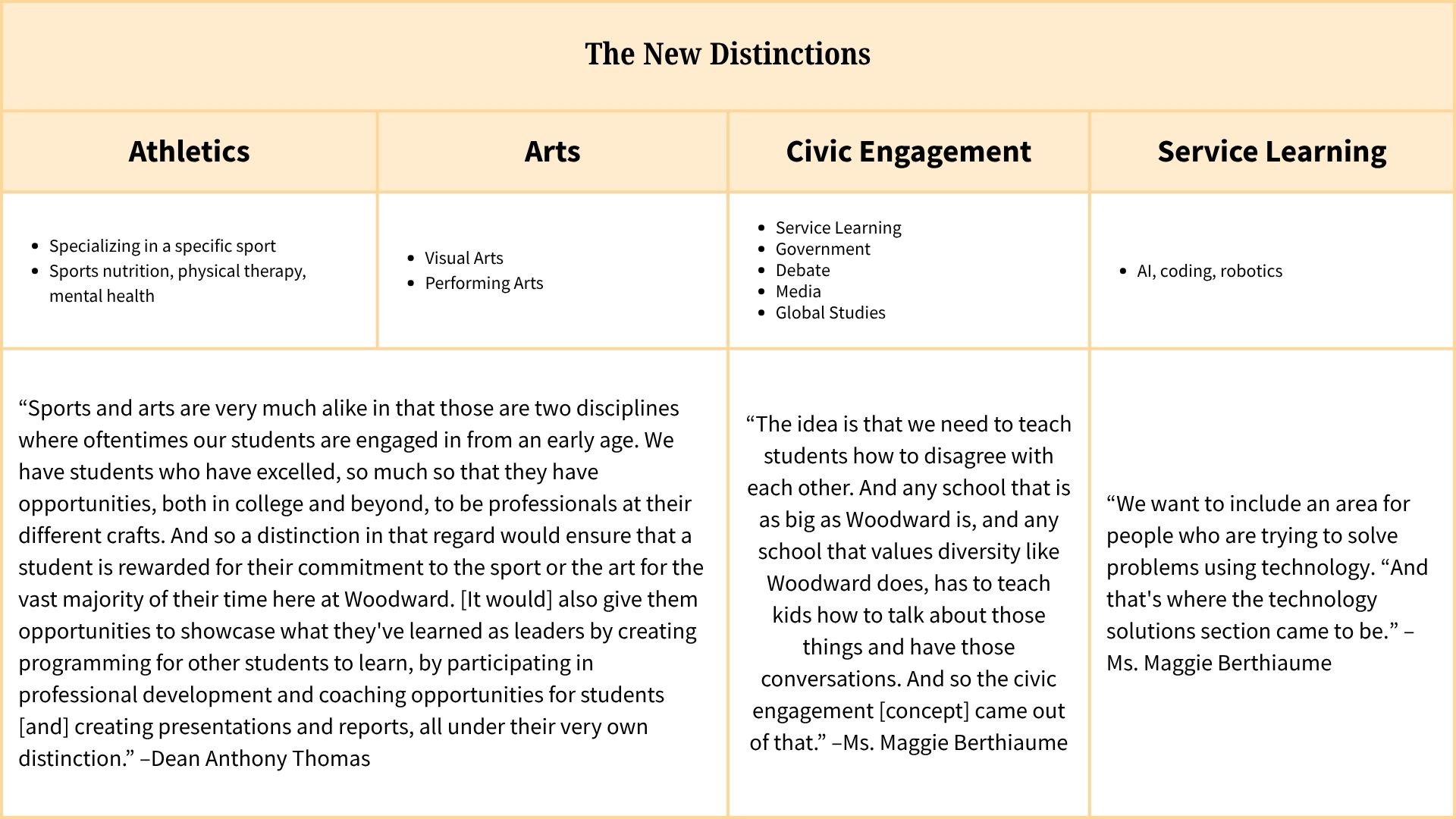
Being the multifaceted institution that it is, Woodward can do anything, but it can’t do everything or be known for everything. Anecdotal feedback from the survey noted that students were looking for opportunities to specialize in an area, but the opportunities weren’t necessarily there. The War Eagle Distinction pillar, formerly called Signature Strengths, sought to find ways for students to showcase their individual and unique strengths and interests and connect them with opportunities at the Academy. The conclusion that the task force presented to the Governing Board was to create more and rearrange the current graduation distinctions.
“When you call it Signature Strengths, people are like, well, why isn’t math a signature strength?” Ms. Berthiaume said. “Or why isn’t writing a signature thing? And those are things Woodward is good at teaching. And so the idea of the distinction is that there are students who are deeply passionate about things at Woodward, and we have programs that allow them to explore those passions.”
Graduation distinctions allow Upper School students to pursue their passion and be rewarded at graduation for their commitment and dedication. The Upper School currently offers four graduation distinctions: Global Studies, Sustainability, Media and Service Learning. The War Eagle Distinctions pillar proposed four new ones: Athletics, Arts, Civic Engagement and Technology Solutions. While the Athletics, Arts and Technology Solutions Distinctions are completely original, the Civic Engagement distinction will introduce new paths such as government and debate while engulfing the current Service Learning, Media and Global Studies distinctions.
“I think if we do it right, kids will be motivated to explore something that they might not have explored already, and then kids who are into something will be able to get more depth in that area than they would have before, or would necessarily at a different school,” Ms. Berthiaume said.
The hope is that these distinctions will become available for students to pursue starting in the 2026-2027 school year. The Co-Leaders hope the impact of implementing the new distinctions will be that students will be more motivated to explore an area of interest and to explore that area with depth.
“Being an alum, I like to see us continue to grow,” Dean Thomas said. “So this idea of creating a strategic plan that addresses any sort of feedback that there is from the community is very important. I think…giving students the opportunity to flourish, if…they love in their own distinctions, it’s a pretty cool concept. I’m just excited to be able to be a part of the process.”
Guided Pathways to College and Beyond
Co-Leaders: Jonathan Merrill, Jodi Hester
Core Team: Anna Thomas, Chato Hendrix, Jesse Bowen, Robert Daugherty, Ryan Davis
News flash, Woodward is a college preparatory school. Survey data from students and parents revealed two overarching ideas surrounding Woodward’s college counseling: firstly, students felt they lacked guidance during the college process and that the guidance started too late, and secondly, parents felt disconnected to the college process as a whole.
The Pathways pillar sought to find ways to expand and enhance Woodward’s mission as a college prep school. To do so, the task force plans to expand the functions of college counseling. College Counseling will make underclassmen more aware of the college process. They will also work to help underclassmen get to know themselves better–their strengths, talent and personality–before junior year. Additionally, using students’ assessment data such as PSAT scores, PreACT scores or even ERB scores from eighth grade will allow the counselors to provide more personalized guidance for each student.
“What we learned from our Woodward community is that there’s a real desire to have earlier action as far as guidance for college counseling,” Dr. Merrill said. “There’s a lot of anxiety about applying to college, and so the earlier [students] feel that they have information, the less anxiety they have. Our real charge, then, is to make people feel at the end of their [college counseling] journey that they were fully prepared with all the information that they needed.”
As College Counseling Director Mr. Bryan Rutledge is retiring this year, the department is currently directorless. Additionally, three college counselors are leaving the staff this year, and the search for replacements is underway. Community recommendations offered the idea to grow the staff from five to six counselors to ease caseload on counselors. While the counseling team is expected to be fully staffed with six by the beginning of the 2026-2027 school year, the Director of College Counseling role will be filled either in spring 2027 or fall 2027 with Dr. Jonathan Merrill guiding the program in the meantime. Spanish teacher and World Language Department Chair Mrs. Lori Beth Wiseman will join the counseling team in fall 2026.
“In terms of our caseloads as college counselors, nobody is as high as us, but I think we do great work,” Ms. Hester said. “But there’s that sense [that] we want more.”

Connected Social Experience
Co-Leaders: Meredith Draper, Mark Carrington
Core Team: Brett Reichert, Carrie Lauchlan, Chris Lewis, Kourtney Mance, Tre Wimby
The Connected Social Experience task force determined two goals for themselves: first, to find ways to create a more open environment where students can connect with each other, and, second, to reevaluate Woodward’s character development program. The team asked themselves questions such as: What is the Woodward Way? What is the character of a Woodward student? Why is Woodward so cliquey?
“Respecting Ourselves, Each Other, Our School, & Our World is the Woodward Way.” How do you get people to buy into the Woodward Way?
“We believe that as an academy we…need to focus on teaching character, but that’s not just something that students have ingrained in them, but that it is something that should be taught,” Mr. Carrington said.
Firstly, Woodward must have a character education program that spans from kindergarten to 12th grade, unifying the school by instilling the same values into all children of whatever age.
“It’s more than just…here’s the student we want you to be,” Mr. Carrington said. “You need to buy into this. We need to teach this. We need to make this a part of our culture. To a point where it almost becomes our identity.”
In order to ensure the program runs smoothly, the task force believes there needs to be a hierarchy of personnel to oversee it and to be held accountable for character education. A staff member would take point on developing the definition of “character” and crafting the program. They’d design metrics to ensure character education is occurring and ensure the education is sustained as students move from grade to grade. Of course, character education is not new to Woodward, as a Director of Character Education already exists in the form of the Director of Character Education and Ron M. Brill Chair of Ethical Leadership, held by Ms. Jennifer Knox. Mr. Carrington noted that this new role will be developed over the next couple of years since the job description for this role isn’t completely fleshed out yet.
“If I am told, as a teacher [that] I need to teach character, I need resources, right?” Mr. Carrington said. “I know how to teach chemistry, I know how to teach physics. I know how to do these things. I know how to grade, I know about educational pedagogy. Nowhere in my education did somebody teach me how to teach character. So probably you’re going to see [professional development] in there somewhere…If we’re going to put this on teachers–which I think we have to, because that’s how a school is organized. That’s where the kids go, especially in the lower grades–Then we’ve got to teach teachers how to do this. So, there needs to be a hierarchy. There needs to be someone who’s responsible for [character education] and who has authority, and that’s what we mean by personnel.”
The other key element to a successful character education program is to get the teachers onboard. Woodward will implement professional development surrounding character education so that teachers can integrate it into the classroom along with their subjects.
While it is evident that the task force has the framework in place for a successful revamp of Woodward’s character and behavior education, there is still no pocketbook of rules on how to be the perfect Woodward student. And obviously, in order to teach character, we have to all be on the same page about what it means. While they did create a starting place for the definition of character at Woodward, creating that definition wasn’t the responsibility of the pillar team. The goal is to create something of a set of traits that any student should embody, regardless of age.
“We aren’t the group to define this term, but we are the group to say, hey, the school needs to spend some time in this area,” Mr. Carrington said. “Let’s get the right people together in the right room.”
Once this character education program is in place, the hope is that Woodward students will be known for being high achievers as well as good people with ethical judgement and concern for others.
The other main focus of the Connected Social Experience pillar was, obviously, to create a more positive social experience for students where they feel closer to one another. The team proposed the Network for Enrichment, Sports and Talents (NEST), an app that guides students to the right extracurricular activities for them. They also want to increase opportunities for students across the Woodward schools to bond, like in a mentorship program.
“[The NEST] would use AI to take all of the clubs and organizations that we have, and…it’s like a chat bot that you could talk to about what you’re interested in,” Mrs. Draper said. “And it would help you find some clubs and get connected to those sponsors.”
***
This strategic plan doesn’t have much of a timeline in place yet. After all, a strategic plan is an ongoing, living document. It is hard to say when Woodward will start to see these plans realized, much less when they’ll start to notice the grand-scheme-of-things impacts. However, the plan’s visionaries believe the changes to come will contribute tremendously positive impacts on students. The strategic plan is still up in the air where the eagles fly. Once the plan proceeds, it’s bound to soar.
In the meantime, to “join the conversation and help shape the future of Woodward Academy,” email [email protected] with your “questions, ideas, or feedback to share.” You should also feel free to email me at [email protected]. I am matriculating to Syracuse University in the fall.