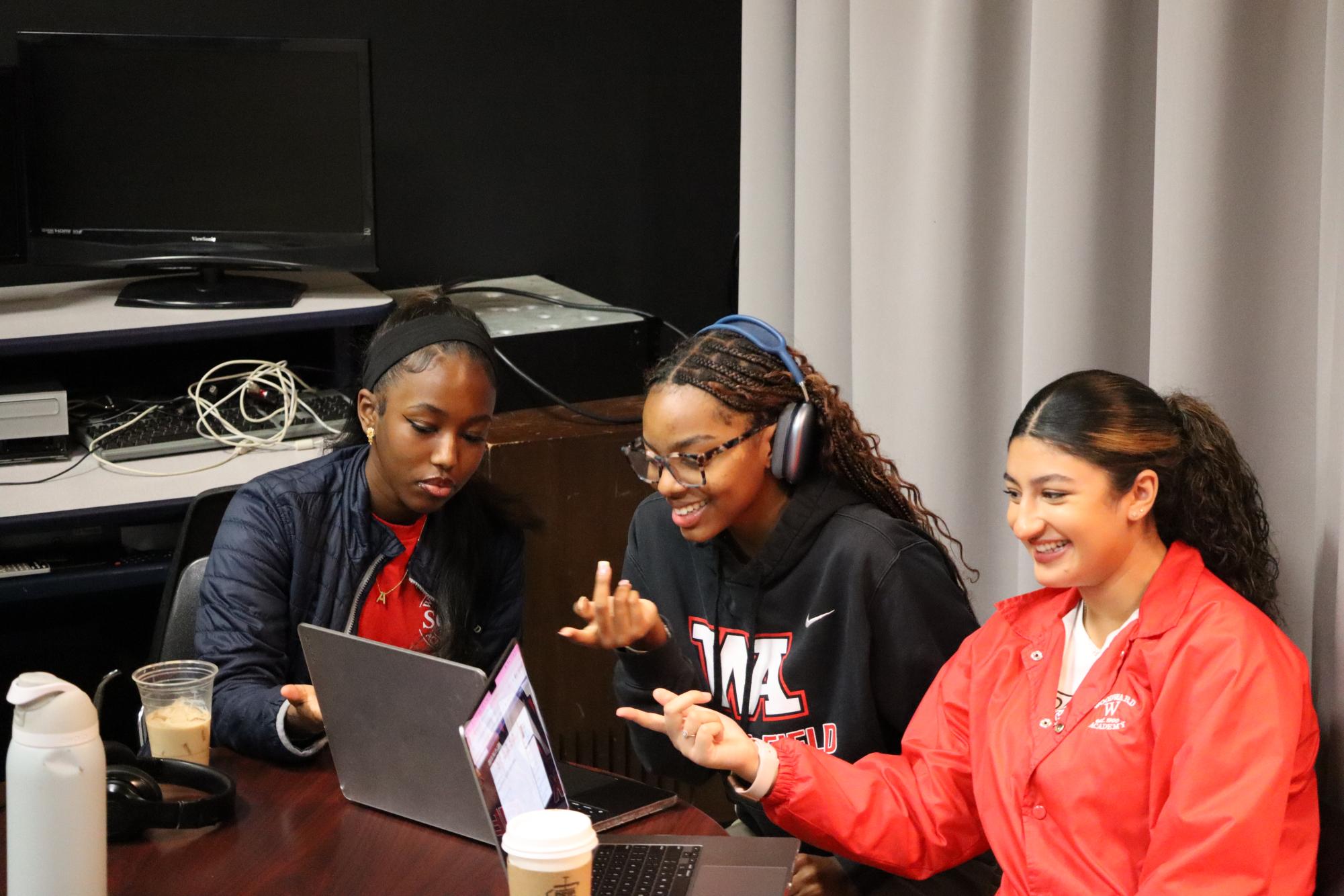
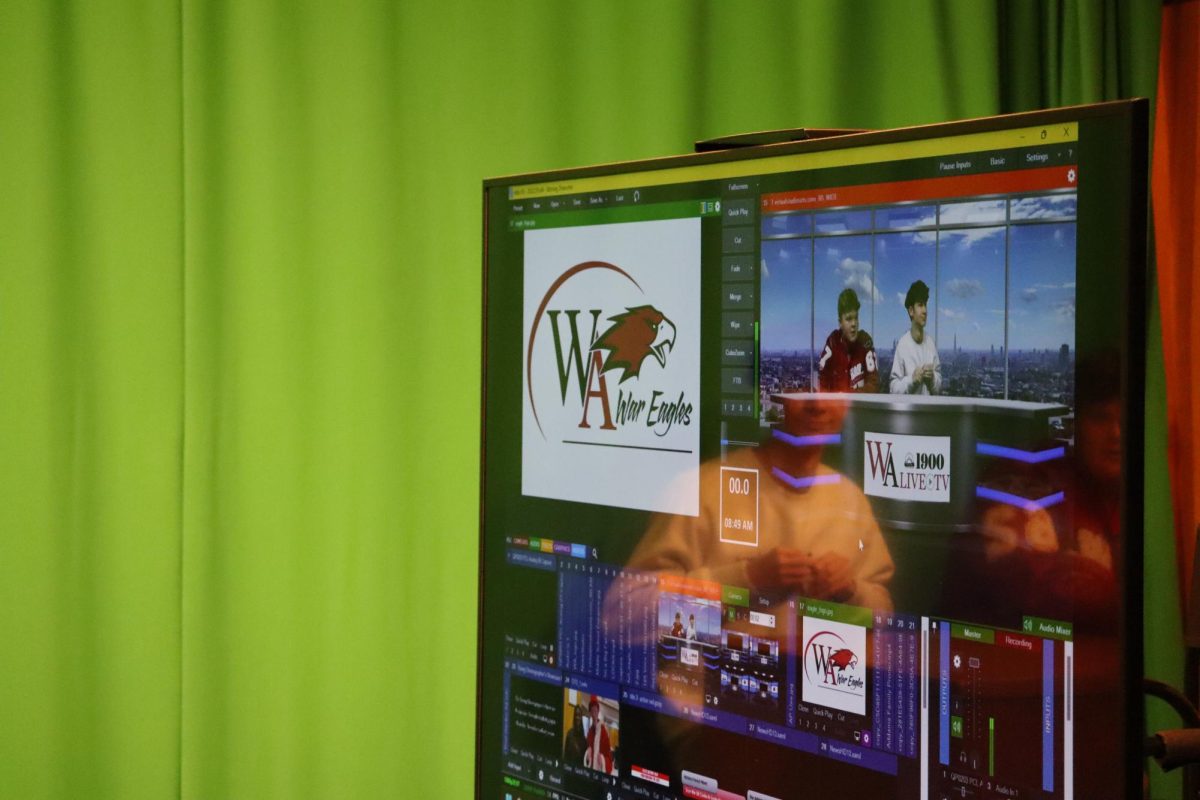
Before the third bell rings and students scramble to tutorial, students watch the Morning Show, which is broadcast to classrooms across campus by WALive. However, each morning, students only hear and see a fraction of the work that goes into getting the daily announcements on air. Long before the first line is read, students are already checking equipment, organizing the script, and fixing last-minute challenges. And by the time the broadcast starts, their goal is to make everything seem natural.
Broadcasting today is one of the world’s most important ways of communication. Through people’s televisions and radios, there is always something connected to broadcasting. Whether it’s to inform someone at a council meeting in town or to update people on the most recent state of a war. The term itself comes from a method of seed planting in agriculture, broadly casting out seeds onto the ground. Today, instead of seeds or farmers, broadcasters are relaying information all over the world. Broadcasting is a way for people to be informed about the current state of the world.
Here at Woodward, things are no different. “The magic of broadcast has woven its way into the fabric of the school’s culture,” according to the Broadcast Handbook used by all students who take one of the broadcasting courses in the Upper School. We utilize broadcasting to educate, inform, and share the school events with its faculty, teachers, and students. To make this happen, the school has created a pair of broadcasting classes (introductory and advanced) available for all students to take. Students in these classes record, edit, and manage daily morning announcements, sports events, and other events that take place at school. According to the broadcasting handbook, there are five positions for the Morning Show, in particular: talent, floor manager, director, audio, and teleprompter.
Overseeing the whole process is Mr. Trevon Broad, the broadcasting advisor for WALive. He guides the students through challenges in planning to deliver the broadcast and makes sure the show is on time and organized. He hopes to set them up for success and expressed what he aims for them to take away from this class.
“Well, I guess the short answer is I hope they get an appreciation for all the behind-the-scenes that go into, not only live broadcasts, but also, even edited and recorded things like this, whether it’s sports, the Morning Show itself, or kind of a news-based program,” Mr. Broad said.
The most essential aspect of the morning announcements is the diverse and significant roles that come together to make them possible, highlighting the teamwork and dedication that drive our daily source of academy-wide communication.
“So downstairs in the studio, there are three jobs, really kind of four,” Mr. Broad said. “We have the two talents, and we have a floor manager and a camera operator. The floor manager and the camera operator would kind of combine. When we do a Middle School show, we have those as separate jobs. So all that [process is] student-run, and then upstairs in the control room is the audio technician, the teleprompter operator (the person who’s running the script, or rolling the script), and then the technical director… well, that’s a dual role. It’s the director and the technical director. So they’re the ones wearing the headset, calling the shots to the whole crew upstairs and downstairs. But they’re also the ones hitting record or maybe even changing the graphics if we do that live.”
Many things go into the Morning Show, but what would it be without its script? The script ensures that the talents are all on the same page, limits mistakes and makes the show entertaining. Without the script, the Morning Show would not be as accurate as it is now. So, what’s the process? Blake Williams ’28, a broadcast student, explained the process by which the script is created.
“You usually have teachers email, like, our teacher, and he puts it into the script himself,” Blake said. “And…so what the people are reading, it’s separated between red and black and paragraphs. So one person reads another, one person reads another.”
While the morning announcements last only a few minutes, the work that goes into filming them is much more involved. Once there’s a script, students follow a structured routine to make sure every part is ready before recording. Broadcasting student, Azariah DeGrace ‘28, shares how long a show could take to be filmed under certain circumstances.
“I mean, so there’s, like, a trial, you have a trial run, a practice run, and then you have the actual thing,” Azariah said. “So, if everything goes correctly, you can take probably 15 minutes max [to record].”
All that said, the two students who come up to the desk and sit in the role of talent don’t have it easy. They read off the teleprompter, which gives them the day’s script. Students often make small mistakes like mispronouncing a name or stumbling over a tricky phrase. If the mistake stays small and can go unnoticed, the talent can continue going. However, when the mistake is bigger, like if they said the wrong room number, then Mr. Broad will decide if they need to start over. Rion King ’26, an honors broadcasting student, illuminated the protocol around mistakes.
“When you mess up, you just kind of keep going, and then our teacher, he’ll be like, if we didn’t mess up that bad, [or] if it’s not that noticeable, then he’ll just keep it going,” Rion said.
But the work doesn’t end once the cameras stop; instead, the production shifts to editing. This step is where graphics, visuals, and finishing details are put together.
“We add the graphics after we record the show in one good take, one solid take,” Mr. Broad said. “So I’ll have a student, who’s usually the teleprompter operator from that day, to help me with the graphics, and, once the graphics are ready to go, that’s where I pull in the show itself.”
And it’s not just students who run into problems; Mr. Broad makes mistakes sometimes as well. The preparation and editing process of the show requires key focus to ensure that everything is done properly. And nobody is perfect.
“I don’t know if you’ve ever noticed,” Mr. Broad said. “Sometimes, if it’s a long, fourpage script and they screw up, kind of, at the end, we will do it like a quick fade, like you may see one kid won’t move at all and another kid will kind of morph a little bit to the left right–but it’s subtle and we can do that, but we really try not to.”
Broadcasting class is not just a fun and interesting course; it also offers students essential skills and insights that can positively impact their future aspirations. A major takeaway is the practical application of these skills in real-world situations. Students like Azariah find that exploring different roles within this course enhances their understanding of the broadcasting field. This hands-on experience not only helps in acquiring technical knowledge but also fosters a versatile skill set, equipping them with the tools to thrive in various broadcasting environments.
“I mean, maybe, like, because I understand camera rules and different camera angles and different types of shots… I could start a YouTube channel or something,” Azariah said.
While Woodward’s broadcast classes are electives, many students learn broadcasting for a variety of reasons, often connected to their interests beyond high school.
“I do broadcasting because I’m interested in taking a media path when I go to college,” Blake said. “So I just wanted some experience in the camera department and filming, trying to get my experience up.”
Broadcasting here at Woodward allows students to experience and learn about the world of broadcasting. Students gain experience through their rotation into the five roles in the studio and learn new skills that they can take with them out into the workforce, such as filming, editing, acting and more. The class itself is challenging at first, but it gets better with practice. This course encourages you to step out of your comfort zone in new and creative ways, making it a rewarding experience.
“The truth is, it’s fun,” Mr. Broad said. “Each job isn’t really that challenging once you know it, but there are a lot of different moving parts. There are a lot of different jobs, but each student’s job is important, but it’s not like a life-or-death kind of thing. So it kind of makes it seem like this is a career you could do. It’s not as high stress or high pressure as you might think.”