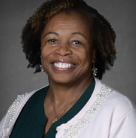
Mrs. D. Monique Williams is a passionate high school math teacher at the Upper School with a very interesting career. Although she now spends her time teaching students in Geometry, Algebra 1, and College Algebra, Mrs. Williams’ career did not start in teaching. Before she became a teacher, Mrs. Williams worked at NASA as a database engineer for the Jet Propulsion Laboratory. Mrs.Williams got her first degree in computer science. She felt drawn to computer science because it was like solving a puzzle using her computer.
“I liked trying to figure out a problem and then logically come up with a way on the computer to make it work,” Mrs.Williams said. “My favorite part of computer science was the database administration part, which is what I did at NASA.”
While working in database administration, Mrs. Williams kept track of the telemetry data, which is wireless data transmitted through dings from the spacecraft.
“The dings would tell us different things about the temperature, the density, different things about the planets,” Mrs.William explained. “We use that to make the actual pictures of what Jupiter, Uranus, Neptune, and all those planets look like.”
Mrs.Williams started at NASA through a summer program for students, particularly minority students. She started as an employee in this program during the summer, two weeks after she graduated from high school.
“They enjoyed what I did,” Mrs. Williams said, referring to NASA. “They enjoyed my work ethic. And so when I went to college…I kept working [there].”
Mrs. Williams described her time at NASA as being exciting and fun overall.
“I got to meet a lot of people from all over the United States when we during an active mission,” Mrs. Williams said.
However, she also remembers the job as being stressful and requiring a constant sense of urgency. Mrs.Williams recalls a specific high-stress incident during her time there, in which they had lost contact with the spacecraft and could not tell whether it was facing the Sun or not, which was crucial.
“If [the spacecraft] was facing the Sun, it was going to come back online when the Sun came out,” Mrs.Williams said. “If it wasn’t facing the sun, then we had lost contact with the spacecraft forever.”
In situations like these, Mrs. Williams often got woken up at absurd hours.
“We all got paged at 2:00 in the morning,” Mrs.Williams said. “We all had to sit there and wait until the sun came out to see if the spacecraft would come back online.”
These stressful and crazy work hours are a main reason why Mrs.Williams decided to stop working for NASA, and, once she had kids, the issue grew.
“I would usually work the hours of eight at night and three or four in the morning cause that’s when I could quickly get my work done,” Mrs. Williams said, since other hours of the day became extremely crowded and slow. “But I knew, once I had kids, I couldn’t keep those kinds of hours, so I prioritized my family over that.”
After moving on from NASA and spending a few years as a stay-at-home mom, Mrs.Williams found her passion for teaching. However, her journey as a teacher began not at Woodward, but at Fayette County, where she worked and taught as math department chair. During her time teaching in Fayette County, Mrs.Williams decided to get a master’s in math education.
“I taught pretty much everything there,” Mrs.Williams said.
In fact, she created a lot of the math classes she taught there for those whose math level did not fit into the rigid curriculum of the school.
“I created a couple of math classes that did not exist in Fayette County,” Mrs. Williams said. “There were a lot of people that fell in between, like seventh and eighth grade math, or eighth grade math was too easy, but they weren’t in high school yet, so I created classes for them.”
After having kids, Mrs.William went back to the schools where her kids went and participated as a room parent. Then, eventually, she was offered the job of a substitute teacher. Mrs. Williams became a very active substitute and was at the school over 100 days of the year, almost working full-time. One fond memory from Mrs.William’s time as a substitute teacher is how students used to call her Miss Candy. Mrs.Williams got this name because she believed in rewarding students for their work, so when she saw students working hard, even if they were not her own, she would reward them with candy.
“It was just a good feeling that students would enjoy when I came around,” Mrs.Williams said. “And I appreciated the fact that I could help so many kids and touch so many kids and make an impact.”
Mrs. Williams’ passion for teaching eventually landed her at Woodward, where she is currently a beloved teacher. Here, she continues to connect with a variety of students, with whom she shares her love of math.
“[N]o matter what, you need to be able to do math, no matter what field you’re in,” Mrs.Williams said. “Math enables you to kind of do so many different things that it’s a good skill to have.”