Generative AI, which became widely popularized after its development in 2022, has put many people in a state of unease or curiosity about this new era of technology. Controversy surrounding the topic has risen in recent years, sparking intense emotions and conversations about its usage. Although AI is a complex issue with more questions than answers, there are a few places to pause and dissect its image in today’s era: effects, ethics and future. Understanding these aspects will help students navigate how they choose to interpret AI, on or off campus.
Student Emotions
It is first important to understand the emotions that surround AI in this current age. In one word, they are varied. Some people look to AI as an innovation that will provide new opportunities for research, education and jobs. Other people can not help but see it as a threat to creativity and a blatant copyright infringer. Katherine Collier ’28 shared her thoughts on the technology.
“I have heard that people have a lot of different opinions about it,” Katherine said. She continued, sharing her own opinion on AI. “Personally, I do not like it. I feel like it takes away from creativity because it samples from what is already there.”
Katherine is not alone in this assessment; many people have mixed feelings about the technology but feel hesitant to engage with it, given the way in which it sources its database.
Whenever a new technology releases, especially as it pertains to school, there are often new limits and expectations put in place to control its usage. Woodward Academy strictly bans the use of AI in work, especially on writing assignments, unless express permission is given by the instructor. The problem is that AI detectors are still being developed, and there is simply no clear way to completely regulate the tool currently. Aria Goyal ’28 shared the same notions as the school and went a bit further to suggest stricter rules around the technology in the academic setting.
“I think the purpose of school is to grow one’s mind, and AI is taking away from that,” Aria said. “There needs to be regulation in schools.”
Advantages and Disadvantages
The ethics of AI, including its sourcing, is a significant issue for many people in multiple ways. AI’s causing of environmental challenges, codependency and fewer job opportunities burdens the average user. Furthermore, because of how AI hallucinates information, it could cause more misinformation to spread. Aria frequently speaks out about the negative effects of AI. She has had negative experiences with the technology and has done further research for debate and essays.
“I think there are more unethical uses of AI [than ethical],” Aria said. “It’s not usually people with integrity using AI. There are also impacts on the environment, the power usage it has… I think there are many ethical uses of AI, in the sense of personal integrity, but not in the big picture, because it’s still using power every time someone uses AI. It’s using clean water.”
There are many positives to AI as well, especially in its effects on the world. Just as AI takes job opportunities, it also has the chance to provide new jobs or make some jobs easier. In the creative sphere, for example, it could potentially help existing animators by completing tedious tasks, allowing them to spend more time on the creative aspects of the job. Research is another large opportunity for AI, as it allows new ideas to be explored at exceptional rates, and some speculate that AI will be the best way to find new cures and medicines. For example, it could assist in cancer research data by finding trends and analyzing large data sets faster than humans can. New technology is often scary because it can take away from the current way things are done; however, it typically provides new ways of doing things as well or makes existing methods easier. Porter Shepard ’28 feels more positive towards AI, considering its many possibilities.
“There are a lot of security problems with AI, especially with deepfakes, but I would say that overall it is a net positive,” Porter said. “It is very useful for providing analytical research, for analyzing data, and doing tasks that are too menial for humans to do. I think it will be integrated into everyone’s life after new technologies are discovered. There are usually a lot of protests at the start, but soon it will be adopted.”
Porter also shared his thoughts on large corporations downsizing on creatives in favor of AI models.
“I think companies will learn the hard way that people do not like using AI art in stuff like companies,” Porter said, regarding creatives. “Companies will learn that they can’t just skimp out on hiring artists.”
This trend has been occurring for a while now with little acknowledgment from the public. Many people who do notice it are concerned by the pattern. Brian Merchant, a journalist, wrote that this happens because “AI products… can recreate images and designs tailored to a client’s needs at rates much cheaper [and faster] than hiring a human artists.”
Additionally, AI often sources its data from creatives without credit or compensation to the creator, because it does not need to under the current copyright law. The majority of creators are not even aware of when their work is being put in these datasets. Many artists take issue with this. Julia Bausenhardt, an artist writing about this issue on her blog, spoke on this. She wrote that “the language models and image generators need samples before they can generate anything” and that the data comes from “human creations, [such as] books, media [and] the internet.” She shared her experience as a creative with this reality, saying she has “already found [her] art in the data sets of image generators” and claimed that “without our data, none of these tools would exist.” Julia is not alone in this assessment. A 2023 survey amongst artists found that 74% of artists believe the way in which AI sources its content is unethical, 89% of artists believe current copyright laws are outdated regarding AI, and 54% of artists worry that AI will negatively impact their income. For these reasons, many creatives question the current state of AI.
A fuller, nuanced approach to the situation would be to understand the multiple perspectives of the issue. Aaliyah Geter ’28 holds this stance.
“I’ve heard positive and negative things about AI,” Aaliyah said. “I’ve heard that it can help students figure out problems when they don’t have resources available to them, like teachers and other classmates to help them. I have also heard that people who can not afford therapy will use it as therapy. I also heard negative things, such as how wasteful it is, as in, it uses so much energy in a wasteful manner, with water, especially. And AI psychosis, there are some pretty negative psychological effects with that. As well as, it will steal people’s art in order to [generate].”
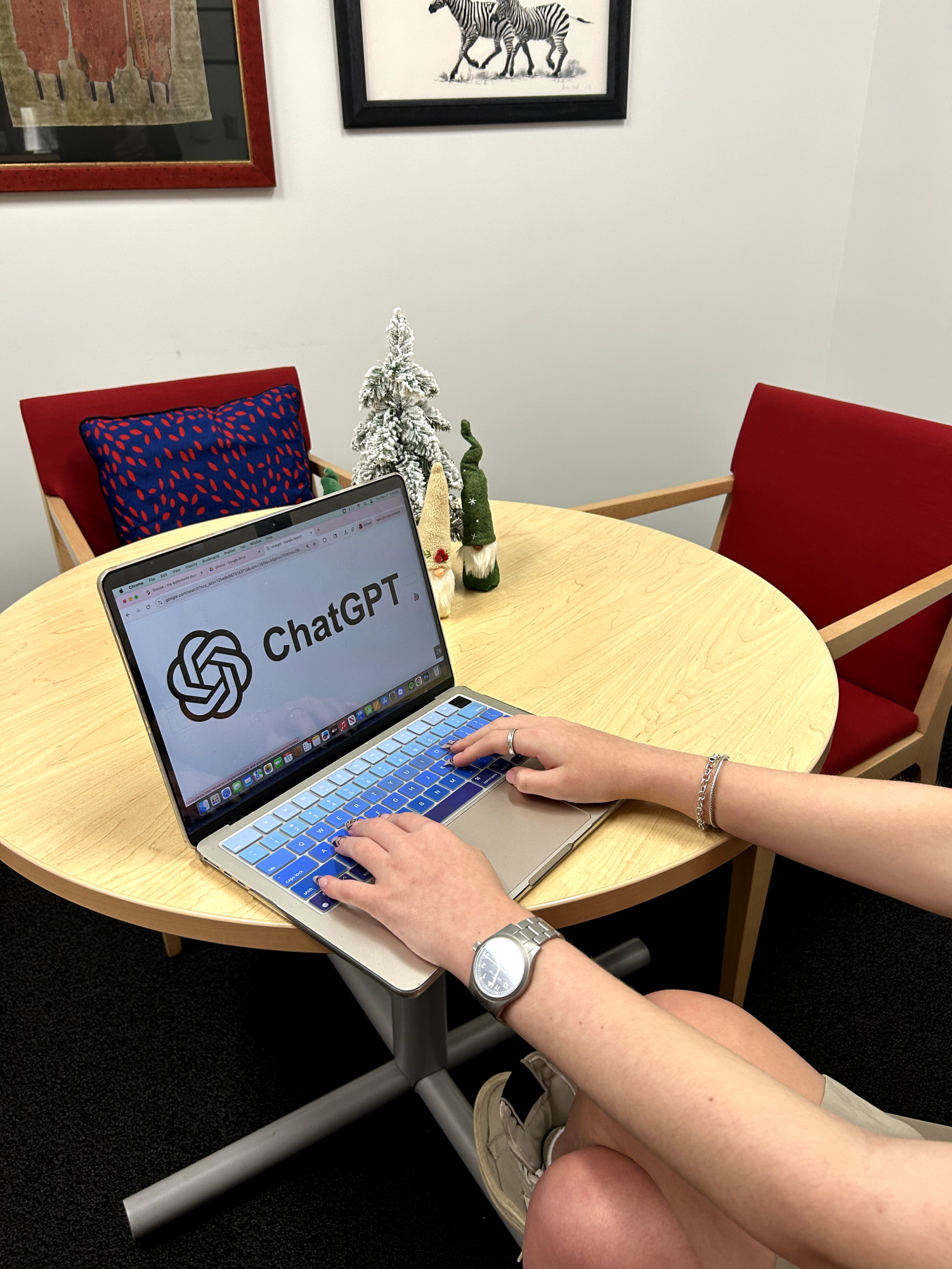
AI’s psychological effects are often an issue that goes unnoticed. It is a large issue that is often overlooked by the population, until extreme cases. The New York Times found that many people are becoming codependent and developing odd relationships with ChatGPT. Kashmir Hill, a feature writer on technology and privacy for the New York Times, claimed that she had been receiving messages from people who believed they had made strong breakthroughs or discoveries through ChatGPT, and that ChatGPT could gain sentience.
Kashmir said that “I assumed at first that they were… delusional people, but then I [found] that was not the case.” She added that “These were people who seemed really rational, who just had had a really strange experience with ChatGPT.” Sometimes these can cause really horrible, lasting effects on the person in this position– Kashmir described some to stop taking medication, or break away from their families. She said she “found out people had had manic episodes, kind of mental breakdowns, through their interaction with ChatGPT.” This is occurring on a large scale– people find themselves dependent on AI. Unfortunately, in the most extreme cases, it has even led to suicide. A teenager named Adam Raine had an extremely dangerous, codependent relationship with ChatGPT, leading up to taking his own life. He had even asked for advice on how to do it, and found that ChatGPT was willing to give him the information. This dependency happens because of what the New York Times coins as the “affirmation loop.” After listening to ChatGPT long enough and being constantly affirmed, they can begin to feel as though they are only understood by it, and no one else. This isolates them from the world around them and pushes an unhealthy, codependent relationship between the user and AI. AI models are coded to agree and affirm constantly, which is relatively harmless until it leads to delusion.
Future
The school atmosphere has undergone rapid changes in recent years due to the implementation of AI in everyday life. AI, used correctly, could help further people’s understanding and bring new, efficient ways of education. If used incorrectly, people are worried that users of AI will become dependent and lazy during workloads. Stress from school causes a lot of people to use AI for the wrong reasons. Mia Wentzel ’27 shared these concerns and worried that people would become too dependent on AI for basic functioning.
“I think people will rely on AI to perform daily functions,” Mia said. “There is science showing that you need to be able to perform tasks; people may lose the ability to know how to cook or research for themself. It encourages students to not do their own work.”
Others believe that AI could help further the understanding of certain topics for students, and that it could work as an extension of tools like calculators. Porter had a slightly different opinion than Mia on the issue, but agreed that AI doing work for students may stunt their skills.
“It is a drastic change in schools, because calculators used to never exist and now they’re allowed in many tests,” Porter said. “The issue is that AI is a much bigger change than a calculator. Calculators will help you do math more easily, and AI will help you do everything. And I would say that AI can reduce a lot of the mental load, but sometimes mental load is what you need to get stronger in a subject.”
The future of AI is uncertain. Putting aside all ethical debates and use cases, there is still a lot of speculation around the path it seems to be heading on. Some people view it as an unprofitable tech bubble that is doomed to fail in due time, and others foresee it becoming a useful part of everyday life that will shape humanity.
A recent study by MIT sparked conversation around the future of AI. This study concluded that “despite the $30-40 billion in enterprise investment into GenAI… 95% of organizations are getting zero return.”
The study provides a nuanced approach, explaining why this may be the case– they come to the conclusion that wide-use AI models are not custom enough to fit into the workflow.
The study believed that “most GenAI systems do not retain feedback, adapt to context, or improve over time”; however, “a small group of vendors and buyers are achieving faster progress by addressing these limitations directly.” While there are changes that can be made, the lack of profit from the majority of generative AI companies risks failure in the industry.
The fact is, the future of AI is unclear; not one person can fully grasp it. Even in a few years, AI could completely change from what we know it is now. AI videos used to be incomprehensible and obviously fake only a few years ago, and now programs like SoraAI create videos that are nearly indistinguishable from reality.
“AI has a lot of possibilities for the future, but it is scary as a creative person, and somebody who wants to go into science, to just think about all the opportunities that are going to shut off rapidly,” Mia said. “It’s changing so fast that, in a few years, our future could look completely different than it does now. It’s daunting. It’s a good daunting.”