Although many people have not heard of the social networking website SixDegrees, it is often regarded as the first social media platform created. When it launched in 1997, it heralded a generational shift towards digital forums with all of their advantages and disadvantages. The title of the platform, SixDegrees, came from the six degrees of separation theory, which entails that every person in the world can be connected by six people or fewer. The website’s name outlined its mission from the beginning: to connect people across the globe with its profile, messaging, and friends features. As the years passed and more companies followed SixDegrees’ lead, social media became a worldwide phenomenon. But as social media grew in popularity, so did the questions surrounding it. As of 2026, almost 30 years later, many questions around the use of social media remain unanswered–including who should be responsible for creating rules for the use of these platforms. The most sensible answer is the government, but that answer alone leads to another set of questions about how government officials use social media.
Before stepping into that quagmire, however, a basic primer on the First Amendment. If you haven’t read it lately, it states that “Congress shall make no law respecting an establishment of religion, or prohibiting the free exercise thereof; or abridging the freedom of speech, or of the press; or the right of the people peaceably to assemble, and to petition the Government for a redress of grievances.” In simpler terms, the First Amendment protects every person in America from being stripped of their basic right to speech, religion, press, assembly, and petition. These protections under the Constitution are clear–most of the time–but what do they mean for Social Media?
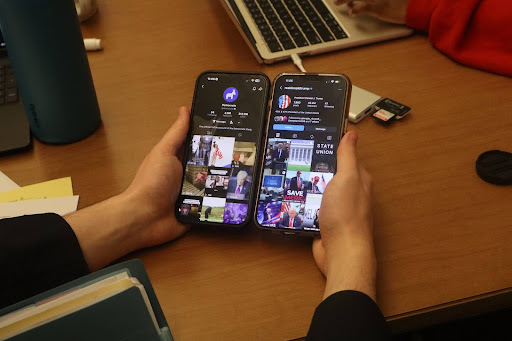
When most teenagers think about social media, they probably think about TikTok or Instagram. What many people also know is that President Trump (TikTok, Instagram), the Democrats (TikTok, Instagram), and politicians like Gavin Newsom (TikTok, Instagram) have accounts on both platforms. Most of the time, these accounts are used for campaigning and comedic relief, like when the official Democratic Party account posts TikToks about missing President Obama. The other posts, however, have more to do with government actions, be it a government official committing to having a bill passed or sharing (or oversharing) official information.
Dr. Jonathan Merrill, who serves as the principal of the Upper School as well as the teacher for Dilemmas in Justice, recognizes that his position at the school comes with a lot of responsibility. In America, the president, congresspeople and judges hold the most power and responsibility, but, in the Upper School, the person in charge is Dr. Merrill. Similar to every president that has been in the White House, Dr. Merrill gets praise for the good things that benefit the community, but is also responsible for the not-so-good things, so every action has its repercussions. And yet, social media seems to be a risk required of anyone who aims to lead.
“I think social media has become an extremely powerful platform,” Dr. Merrill said. “So, [for] any politician that is, you know, interested in advocating for a policy that is of interest to anyone basically under thirty, social media is the most effective way to get that message out. So I think we’re gonna see more and more politicians using social media to advocate for policy positions, but that definitely concerns me because right now there’s not really good regulation on social media. There’s not a check on social media in the way that historically there’s been a check on the press. So the press is specifically kind of enshrined in our Constitution to be a check on the government. I don’t think anyone sees social media as being a check on the government. That really makes me nervous, particularly when I see the amount of disinformation on social media.”
Dean Stephanie Stephens is the academic dean of the Upper School as well as a teacher of the capstone course called Civil Liberties. Aside from her leadership position at Woodward Academy, she also worked in the military as an Army lawyer, or JAG. As someone responsible for keeping confidential information secure during the course of serving her country, Dean Stephens largely opted out of social media to avoid the infinite issues that could possibly arise from it, especially during her primary years of service. Fortunately, at the time, the threat of social media was minimal; however, now this threat is massive and invades even the highest levels of government. Officials must find a way to defend themselves against these new forces as well as understand their role in this new age.
In particular, Dean Stephens considered the recent Signalgate fiasco as she explained her thoughts on the risks of social media. Signal is a messaging app that prioritizes privacy by deleting messages soon after they are sent, similar to Snapchat, retaining minimal data, and, among other things, providing end-to-end encryption. Despite the many precautions, when a person is added to a group chat on Signal, every message in the chat becomes available to them, which is why it was extremely alarming from a security perspective when a reporter was added to a Signal group chat discussing classified information about an ongoing military action, which happened to include many high profile officials in Trump’s administration like Vice President J.D. Vance, Defense Secretary Pete Hegseth and now former-National Security Advisor Mike Waltz. The head editor of “The Atlantic,” Jeffrey Goldberg, took several screenshots of the conversation, which was discussing sensitive military strikes in Yemen. This potentially catastrophic leak raised many concerns about the government’s handling of classified information.
“It was a military action over social media,” Dean Stephens said. “It was supposed to be a social media [network] that was purely in the military, and it was supposed to be classified, but one person put a journalist on there. Well, then it’s out and, you know, the thing about social media and the internet in general is that once something is out there, it’s out there forever.”
Even if the lives of troops aren’t on the line, Dr. Merrill is still responsible for over 1,000 Upper School students, not to mention a whole brigade of teachers. Thus, while he has the same freedom of speech rights as students, Dr. Merrill recognizes that just because speech is protected, it doesn’t mean it is without consequences. He considers his words carefully and understands that whatever statement he makes will have a larger impact than that of others.
“I’m thinking about myself, personally,” Dr. Merrill said. “If what I post on social media has a detrimental impact on the institution that I work for and represent, I should expect consequences for that. In other words, if I posted something on my personal social media that criticized Woodward or put Woodward in a bad light, I should not expect that I am free from consequences.”
Mr. Hunter Smith, an AP government and political economics teacher, is an expert in all things related to the U.S. government. He has a similar view on the responsibilities of government officials as his colleagues do.
“I think that when you run for political office, and you hold official power, there are some limits to all of your freedoms that go along with that, that you accept and know when you go into that job,” Mr. Smith said.
While the First Amendment applies to every person in the U.S., those with important roles in the government have modified freedoms, and their capacities to speak officially don’t coincide with their private speech. While they can technically say whatever they want, when President Trump took to Truth Social to announce that credit cards would have a cap of 10% interest rates for a year, he was using his voice as a private individual on a nationwide issue rather than as president (presidents do not have the ability to impose rules on private banks). Despite interest rate hopes, Trump has not suggested a method to create this cap, enforce it, or deter the many cons of creating a cap, such as decreasing the profitability for banks and even hurting consumers by forcing banks to limit borrowing.
“I mean, to me, that [post] is an elected official using social media as a platform to advocate for a certain policy position, and to me, that’s much the same as if he said it on TV or it was published in the newspaper,” Mr. Smith said. “Certainly, all stripes of politicians today are trying to find ways to use social media because it is a more direct way to communicate with [their] own supporters.”
AP government student Pate Jones ’26 is part of the generation that grew up on social media, and when asked if she believes everything she sees online, she said no.
“Knowing that, like, it takes a long time for policy to be approved and enacted and enforced, I wouldn’t entirely believe [posts from government officials],” Pate said. “It’s a little overzealous to claim that you’re gonna implement a policy when there are so many, like, government processes you have to go through first.”
The grey area between posting hopes and posting facts furthers the uncertainty of social media for the government. Is it appropriate for a president or any politician or government official to post about topics he or she has no authority over? And, appropriateness aside, how seriously should citizens take said posts?
To see where this gets complicated, take a look at the case of James Freed. James Freed, City Manager and Chief Administrative Officer of the City of Port Huron, Michigan, created a social media account updating people on policies and public health during the pandemic. In some of Freed’s posts, concerned citizen Kevin Lindke commented, criticizing Freed and the city’s handling of the pandemic. Freed deleted Lindke’s comments, and, in return, Lindke sued Freed for violating his First Amendment right to freedom of speech, creating the case Lindke v. Freed. The court issued a clarifying order that state action within a social media post–such as that taken by Freed–can only be done if the person has the authority and means to exercise that authority when posting on a social media account. As the City Manager, Freed did have the authority to make posts about public health during the pandemic and had the means to make posts about it, therefore meeting the requirements made by the Supreme Court. With many government officials like Freed using social media as a way to get their point across, rules regarding social media are less likely to come to fruition, as they would be a disadvantage to the rulemakers.
“I think it’s gonna be kind of a gray area because the people making the rules, politicians, generally make rules that serve their interests,” Dr. Merrill said. “I think that’s not a criticism of our government, but it is human nature that, um, it’s pretty rare to have politicians make laws that are hurtful to their own political interests and ambitions.”